FinOps
Vantage, CloudZero, Cloudability: which FinOps SaaS tool to pick under $100K/month on AWS
Is Cost Explorer still enough? A hard-numbers comparison of Vantage, CloudZero and Cloudability for an AWS organization spending $10K-$100K/month: real pricing, what they add over native, and when to stay on AWS alone.
The FinOps Foundation’s State of FinOps 2026 report, based on 1,192 respondents representing over $83 billion in annual cloud spend, measures self-reported cloud waste at 29% — the first increase in five years, driven by the weight of AI workloads. Faced with that number, the immediate reflex is to subscribe to a FinOps SaaS tool to regain control. But between AWS Cost Explorer (free, already enabled) and Cost Optimization Hub (free since 2024), the real question for an organization spending $10K-$100K/month on AWS isn’t “which tool should I pick” — it’s “do I actually need to pay for one.”
This article compares three independent FinOps SaaS tools — Vantage, CloudZero, and Cloudability (IBM/Apptio) — on the organization segment, with real pricing and what each concretely adds over native AWS.
What native AWS already covers in 2026
Before reaching for a credit card, it’s worth measuring precisely what AWS already gives away for free:
- Cost Explorer: spend visualization by service, account, and tag, with 12-month forecasting. Sufficient for a single account with disciplined tagging.
- Cost Optimization Hub: centralizes recommendations from Compute Optimizer, Trusted Advisor, and Cost Explorer into a single organization-wide view — launched in 2024, still underused by organization teams in 2026.
- AWS Cost Anomaly Detection: automatic alerts on unusual spend deviations, free, enabled per service or account.
- Cost Categories + Cost Allocation Tags: allow team/product-level breakdowns without a third-party tool, provided a tagging plan is enforced from resource creation.
The documented limits of native tooling are real: these tools are recommendation-only (no automated Savings Plans purchasing, no execution of resizing recommendations), lack multi-cloud visibility, and team-level allocation stays manual and fragile the moment tags aren’t applied everywhere. That’s precisely the gap FinOps SaaS tools sell against.
For an organization on a single AWS account with fewer than 50 resources and disciplined tagging: native tooling is enough. The practical threshold where a third-party tool starts paying for itself sits around €15-20K/month of AWS spend, or as soon as multiple accounts/teams need cost allocation.
Vantage: the most accessible entry point
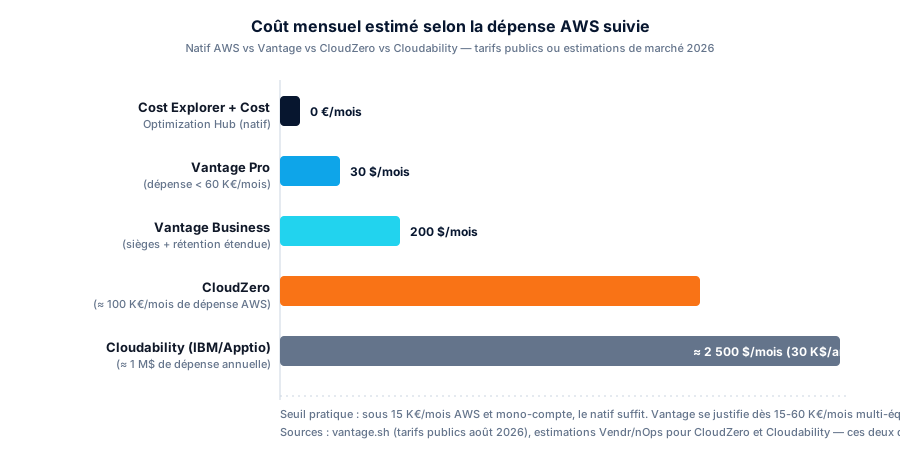
Vantage is the only one of the three that publishes a complete self-service pricing grid. 2026 structure:
- Free up to $2,500 of tracked cloud spend — capped by volume, not by features.
- Pro: $30/month, for teams past the free tier without heavy volume.
- Business: $200/month, with extended retention and additional seats.
- Enterprise: above $20,000/month of tracked spend, quote-based.
Strengths for an organization: native multi-cloud integration (AWS, GCP, Azure), support for SaaS and AI costs via FOCUS-compatible uploads, ready-to-use collaborative dashboards without heavy setup. It’s the fastest tool to deploy for a 5-to-50-person team wanting a consolidated view without a sales negotiation.
Limitation: past the Business tier, the model shifts to quote-based Enterprise pricing — the pricing transparency that makes Vantage attractive at entry level disappears once AWS spend crosses roughly $60-80K/month.
CloudZero: the deepest on feature/customer-level allocation
CloudZero publishes no fixed pricing — every contract is a quote based on annualized cloud spend. 2026 market estimates put a $100K/month AWS bill at roughly $1,500-$3,000/month in CloudZero cost, with unlimited user access and predictable billing (no overage if cloud spend spikes in a given month).
What sets CloudZero apart: the ability to tie infrastructure cost to business units (cost per customer, per feature, per API request) rather than a plain breakdown by service or tag. For a B2B SaaS organization that needs to answer “how much does this customer cost us” or “what’s the margin on this feature,” this is the most directly usable angle in a board meeting. CloudZero also holds AWS Partner status for AI cost allocation — an increasingly important axis given the FinOps Foundation figure above (98% of organizations now manage AI spend, up from 31% two years ago).
Limitation: the lack of published pricing complicates upfront comparison — expect a sales cycle with a quote before you can model the ROI.
Cloudability (IBM/Apptio): built for large-scale multi-account setups
Cloudability charges as a percentage of cloud spend under management, on an annual commitment. 2026 benchmarks (Vendr/nOps data): roughly $30,000/year for $1M of annual cloud spend, $76,000-$132,000 for $3M-$6M. A free tier exists up to three cloud accounts.
This is the tool best suited to organizations with mature FinOps governance — formalized cross-team chargeback, consolidated financial reporting across multiple business units. For an organization under $100K/month on AWS, the entry ticket (tens of thousands of dollars per year, annual commitment) far exceeds the added value over Vantage or native AWS. Cloudability starts to make sense once cloud spend exceeds a few million dollars a year across several business units with distinct financial reporting needs — a rare profile under 200 employees.
Decision grid for an AWS organization
| Situation | Recommendation |
|---|---|
| < $15K/month, single account, clean tagging | Cost Explorer + Cost Anomaly Detection + Cost Optimization Hub, no third-party tool |
| $15-60K/month, multiple teams/accounts | Vantage (Pro or Business) |
| Need cost-per-customer/feature allocation (B2B SaaS) | CloudZero, negotiate the quote on actual volume |
| > $1M/year, multiple business units, formalized financial chargeback | Cloudability |
| Significant AI spend already (Bedrock, SageMaker) | Vantage or CloudZero, both with dedicated AI allocation — verify FOCUS support before signing |
What the three tools have in common: none replaces a tagging plan enforced at the source. A FinOps SaaS tool on top of poorly tagged infrastructure just displays the uncertainty more nicely — building the cost taxonomy (Cost Categories, mandatory tags via Service Control Policy) has to precede the subscription, not follow it.
What we recommend on engagements
In FinOps audits at Distribuée, the sequence that works: first fully exploit the free native tools for 60 to 90 days, with a strict tagging plan enforced by SCP. If allocation still falls short after that phase — typically once more than three product teams share the same accounts — a Vantage trial on its free tier (up to $2,500 of tracked spend, plenty for a pilot) lets you judge the added value before any financial commitment. CloudZero is reserved for organizations with a real business question to answer (cost per customer), not as a first FinOps reflex.
A FinOps tool never fixes a poorly optimized architecture — it just exposes it faster. Rightsizing, Savings Plans, and cleaning up orphaned resources always come before adding another line item just to visualize them.
Found this useful? Share it.
Go further
A topic, a project, a question?
Distribuée supports demanding SMBs on cloud security, CI/CD supply chain and AI security.
Book 15 min