FinOps
ProsperOps and Savings Plans Automation: Real ROI, Pitfalls, and When It's Not Worth It
ProsperOps automates AWS Savings Plans purchasing and laddering via a Savings Share model. Real ROI against the native Cost Optimization Hub, and when an organization should skip it.
Our Savings Plans vs Reserved Instances decision tree answers “which commitment mechanism should I pick.” This one answers a different question, raised by several clients during FinOps engagements this summer: should you pay a third-party tool to manage those commitments for you? ProsperOps is the name that comes up most often — it’s the incumbent in “Autonomous Discount Management” on AWS, Azure, and Google Cloud. The pitch is appealing on paper: zero manual intervention, continuous purchasing, nothing to configure. The price you actually pay for that deserves to be spelled out before signing.
The real problem: a commitment frozen once a year is almost always sub-optimal
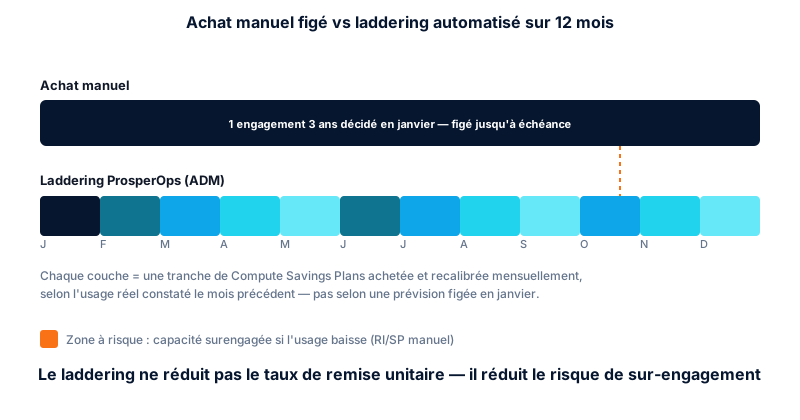
Manual Savings Plans management suffers from a simple structural flaw: it happens in bursts. A FinOps or infra team reviews the bill once or twice a year, calculates a commitment based on the last three months of usage, buys a Compute Savings Plan for 1 or 3 years, and doesn’t touch it again until the next review. Between reviews, two things happen: real usage drifts (scaling up, a Graviton migration, a service getting decommissioned), and a growing slice of the bill goes uncovered because nobody has time to recompute the delta between commitment and consumption every month.
AWS’s own published numbers show the gap between mechanisms: a 3-year Compute Savings Plan cuts the bill by up to 66%, a 3-year EC2 Instance Savings Plan by up to 72% — but only if coverage (the share of usage actually covered by the commitment) stays high continuously. A commitment bought in January and never rebalanced typically loses several points of coverage per quarter on infrastructure that keeps moving. That delta — not the discount rate AWS publishes — is what automation tools are actually selling.
How ProsperOps’ automation works (Autonomous Discount Management)
ProsperOps doesn’t replace AWS’s native mechanisms — it drives them continuously through three layers, explicitly broken out in its customer contracts:
- Inherited Savings: savings already generated by Reserved Instances and Savings Plans the client had purchased themselves before onboarding — ProsperOps doesn’t bill these as its own performance, but folds them into the overall coverage calculation.
- Base Savings: Compute Savings Plans bulk-purchased by ProsperOps on the client’s behalf, based on a usage baseline judged stable.
- Smart Savings: the differentiating layer — an adaptive laddering mechanism that buys and rotates monthly Compute Savings Plan tranches instead of a single frozen commitment, recalculating the best combination of durations and tranche sizes every month.
Laddering doesn’t change the unit discount rate negotiated with AWS — that rate is set by AWS, not by ProsperOps. What it changes is reaction speed: instead of one commitment decided once a year against a forecast, you get twelve decisions a year against usage that’s already been observed, which cuts the risk of over-commitment (paying for capacity you don’t consume) without sacrificing coverage. The companion module, Autonomous Resource Management (ARM), pushes the same logic down to resource rightsizing itself, but is currently restricted to customers already on the Compute ADM offering.
The pricing model: Savings Share, not a subscription
ProsperOps doesn’t charge a flat subscription or a percentage of total cloud spend — worth confirming upfront with any prospect, since the confusion is common. The billed model is called Savings Share: a percentage applied only to savings actually realized according to AWS’s own billing system, with a different rate depending on whether the layer is Inherited, Base, or Smart Savings (the Smart Savings layer, higher value-add, is billed at the highest rate).
The exact rate isn’t published — it’s negotiated per contract and varies with usage volume. As an order of magnitude: if a contract sets a 25% rate on a given layer and ProsperOps generates €100,000 in monthly savings on that layer, the corresponding ProsperOps bill is €25,000, netting €75,000 of real savings for the client. Third-party analyses published in 2026 cite ranges of 20-35% depending on the layer and contract — to verify case by case, never to take for granted from a quote. The break-even point commonly cited by integrators selling the tool: below roughly $10,000/month of AWS compute spend, the gross savings generated usually don’t justify the setup (onboarding time, contract review, ongoing billing to monitor).
The calculation that actually matters for an organization: net ROI against Cost Optimization Hub
This is the point most often skipped in sales pitches: since 2024 AWS has offered a native, free tool, Cost Optimization Hub, which consolidates recommendations from Compute Optimizer, Trusted Advisor, and Cost Explorer, including term (1 or 3 year) and payment-option preferences for Savings Plans and reservations. It’s not an execution tool — it recommends, it doesn’t buy, and it doesn’t do monthly laddering — but for an organization with stable infrastructure tracked by a dedicated person, it covers most of the problem at zero cost.
The ROI calculation for a tool like ProsperOps boils down to one question: what is it worth, in money, to not have to execute the recommendation yourself every month? For a $30-80K/month AWS footprint with usage that moves (irregular scaling, frequent migrations, multiple accounts), the coverage gap between a frozen commitment and monthly laddering can represent several points of the bill — comfortably above the Savings Share taken. For a stable footprint under $15-20K/month with an instance mix that almost never changes, the gap is marginal, and Cost Optimization Hub paired with a quarterly human review captures most of the value without handing 20-35% of the savings to a third party.
The competitive landscape: ProsperOps isn’t alone here
ProsperOps remains the historical reference on pure compute-commitment automation, but the space has filled in. nOps claims an additional performance delta through finer hourly optimization rather than longer commitments, at a comparable Savings Share price point. DoiT International (FlexSave) applies a similar logic but backs it with its position as an AWS reseller, which changes the billing structure. The general-purpose FinOps tools covered in our Vantage / CloudZero / Cloudability comparison give visibility into cost allocation but don’t purchase commitments on the client’s behalf — they’re complementary layers, not competitors, to what ProsperOps does.
Recommendation for an AWS organization
Three concrete situations from our audits:
- Stable infrastructure, under $15-20K/month, someone already tracks costs: Cost Optimization Hub plus a quarterly review is enough. Paying a Savings Share doesn’t make economic sense.
- Infrastructure that moves (scaling, migrations, multiple accounts), $30K/month and up, nobody has time to recompute commitments every month: automation has a real use case — the Savings Share cost stays net below the coverage delta lost to quarterly manual management.
- Somewhere in between, or before signing anything: a DevSecOps audit quantifies the real coverage delta on your own billing history before you sign anything with a third party — that’s a verifiable number computable in a few hours with the Cost Explorer API, not an estimate.
The question is never “does the automation work” — it works, the laddering mechanism is solid and well documented. The question is “does the delta it captures on your infrastructure exceed the cut it takes.” On stable infrastructure, often not. On infrastructure that moves with nobody dedicated to watching it, often yes.
Found this useful? Share it.
Go further
A topic, a project, a question?
Distribuée supports demanding SMBs on cloud security, CI/CD supply chain and AI security.
Book 15 min