Ecosystem
Prisma Cloud (Cortex Cloud): overkill, or genuinely worth it against Wiz and Orca?
Prisma Cloud is now Cortex Cloud at Palo Alto Networks. Against Wiz (acquired by Google) and Orca, does it earn its place in an AWS organization's security budget, or is it overkill?
If you’re still searching for “Prisma Cloud” in Palo Alto Networks’ catalog, you won’t find it under that name anymore: since February 2025, the platform is called Cortex Cloud, and the migration of existing customers wrapped up in the editor’s fiscal Q3 2025. The product itself — CSPM, CWPP, CIEM, IaC scanning — is largely the same, but it’s now merged with the detection-and-response (CDR) capabilities of the Cortex line. For an organization evaluating a CNAPP in 2026, the question isn’t “Wiz or Prisma Cloud” anymore — it’s “Wiz, Orca, or Cortex Cloud” — and the third name is likely to sound less familiar than the first two, even though it remains a serious contender on paper.
This piece complements our Wiz vs Security Hub + GuardDuty comparison: here, the question is specifically whether Cortex Cloud (formerly Prisma Cloud) belongs in the security budget of a 50-to-200-person AWS organization, versus Wiz and Orca — the two other names that keep coming up in shortlists.
What Cortex Cloud does best — and where it gets heavier
Cortex Cloud isn’t a technical also-ran. On paper, it’s the most complete CNAPP platform on the market: CSPM, CWPP (runtime protection with both agent-based AND agentless options), CIEM, IaC scanning, Cloud Detection and Response, and native integration with the rest of the Cortex ecosystem (XSIAM, XDR) if you’re already a Palo Alto Networks customer on the network or endpoint side. That last point is exactly what tips the balance for some accounts: a company that already runs a Palo Alto firewall or Cortex XDR gets one unified console, not yet another tool in the stack.
That’s also where it bites for an organization without that existing footprint. Field feedback converges on three points:
- The highest operational complexity of the three major CNAPPs — multiple modules to enable and configure separately (CSPM, CWPP, CIEM, Code Security license independently), agents to deploy if you want full runtime coverage, and a real learning curve for a 2-3 person team that also carries security on top of everything else.
- An opaque pricing grid — the model is credit-based, consumed hourly depending on resource type and active module. Palo Alto Networks doesn’t publish a public consumption rate card per resource type: it’s a sales conversation, not something you can compute yourself upfront.
- A clearly enterprise/regulated positioning — Cortex Cloud is frequently cited as the strongest fit for organizations with heavy runtime compliance requirements (healthcare, finance) rather than a typical B2B SaaS organization that just wants a clean AWS posture.
What it actually costs
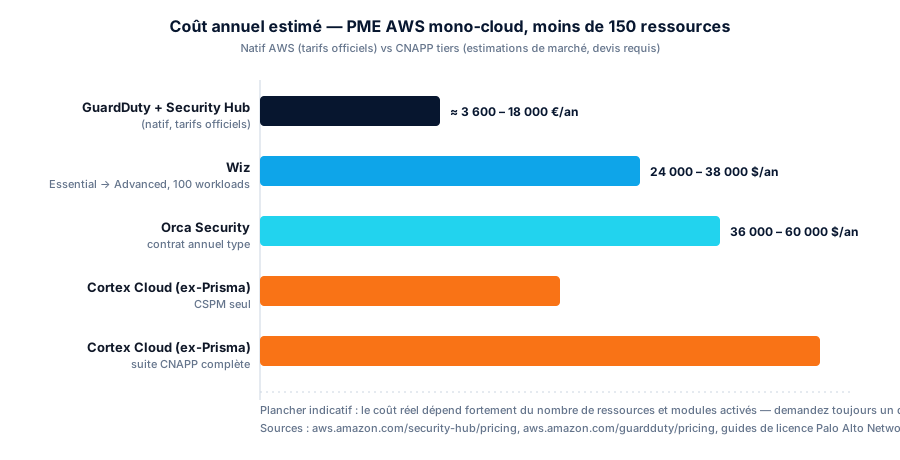
None of the three third-party CNAPPs publish a complete, binding rate card — all three run on quotes. Here are the market ranges observed as of late 2026:
- Cortex Cloud (formerly Prisma Cloud): credit-based model, roughly $1.20/credit. CSPM alone starts around $18,000/year; the full CNAPP suite (CSPM + CWPP + CIEM) starts around $45,000/year. Business Edition ≈ $9,000 per 100 credits/year, Enterprise Edition ≈ $18,000 per 100 credits/year — but actual credit consumption depends on the number and type of active resources, so these floors climb quickly in practice.
- Wiz: no public per-workload rate card. Market data observed on AWS Marketplace puts the Essential tier around $24,000/year for 100 workloads, and Advanced around $38,000/year.
- Orca Security: also quote-only (no self-service, no free tier). Typical annual contracts observed sit between $36,000 and $60,000/year, with per-unit cost decreasing as volume grows.
- Native GuardDuty + Security Hub: as a reminder, a single-cloud AWS organization with fewer than 150 resources typically pays between €3,600 and €18,000/year for the native combination — often a factor of 2 to 10 below the three third-party CNAPPs.
Treat these as market benchmarks, not quotes: always request a priced proposal for your exact footprint — all three vendors negotiate heavily based on volume and contract length.
Wiz, Orca, Cortex Cloud: three different logics, not three flavors of the same product
The CNAPP market consolidated further in 2026 — Google’s $32 billion acquisition of Wiz, closed on March 11, 2026, is the most visible symbol of that, and Wiz remains the market-share leader today (17.4% CNAPP “mindshare” per PeerSpot, February 2026, versus 6.3% for Orca). But market share doesn’t mean best fit for your case:
- Wiz wins on the fastest deployment (full risk profile in under 24 hours), the most legible attack graph, and the best developer integration — the default choice if you’re starting from zero and want to be up and running immediately.
- Orca Security is the most commonly cited Wiz alternative: agentless like Wiz, optional eBPF runtime sensors, slightly narrower native cloud coverage (no OCI or Alibaba Cloud), but generally lower operating cost than Wiz at comparable coverage, and independence from any hyperscaler — an argument that carries more weight now that Wiz belongs to Google.
- Cortex Cloud wins on runtime depth (native agents, not just agentless), stronger compliance for regulated sectors, and real added value if you’re already invested in Palo Alto Networks on the network or endpoint side — but loses on implementation simplicity and pricing transparency.
For an AWS organization with 50-200 people, no pre-existing Palo Alto Networks footprint, and no strong sector-specific regulatory constraint, Cortex Cloud is structurally the least natural candidate of the three — not because it’s technically worse, but because its complexity and entry ticket are calibrated for larger organizations.
When Cortex Cloud is the right call anyway
- You already run a Palo Alto Networks firewall or Cortex XDR in production — the unified console and cross-domain correlation (network + endpoint + cloud) offer real value that neither Wiz nor Orca can match.
- Your sector imposes strict runtime compliance (healthcare, finance, critical infrastructure) where agent-based CWPP depth matters more than deployment simplicity.
- You have a dedicated security team (not just 1-2 people also carrying DevOps) able to absorb multi-module configuration complexity.
- Your annual security budget comfortably clears $45-50K, and bundled negotiation with other Palo Alto Networks products brings the effective price down.
When to stick with Wiz, Orca, or native AWS
- You’re starting a CNAPP initiative and want fast time-to-value without complex integration: Wiz or Orca get to production faster.
- You have no existing Palo Alto Networks footprint to leverage — paying Cortex Cloud’s entry ticket without that synergy means paying for complexity you won’t use.
- Your footprint stays under 150 resources and single-cloud AWS: in that case, the first question isn’t even Wiz vs Orca vs Cortex Cloud, it’s “have we actually exhausted GuardDuty + Security Hub” — see our detailed comparison.
Our take
The Prisma Cloud → Cortex Cloud rebrand didn’t change the product’s position: it’s still the most complete and most complex of the major CNAPPs, built for organizations that already have a dedicated security team or an existing Palo Alto Networks footprint to leverage. For the vast majority of AWS organizations we audit, neither Cortex Cloud, nor Wiz, nor Orca is the first brick to lay — that’s fully configuring the relevant GuardDuty protection plans and Security Hub standards for your sector. A DevSecOps audit settles objectively whether your finding volume and exposure justify a third-party CNAPP, and which of the three fits your structure — rather than defaulting to whichever name ranks highest in search results.
Conclusion
Cortex Cloud (formerly Prisma Cloud) remains a serious CNAPP, but its entry ticket — $18,000/year for CSPM alone, $45,000/year for the full suite — and operational complexity reserve it for specific profiles: existing Palo Alto Networks synergy, regulated runtime compliance, or a dedicated security team. For a standard AWS organization, Wiz or Orca remain faster to implement, and native AWS (GuardDuty + Security Hub) remains, in most cases, the first step to exhaust before signing anything five figures.
Sources: Prisma Cloud Enterprise Edition licensing guide, Cortex Cloud announcement — Palo Alto Networks, Google completes Wiz acquisition, AWS Security Hub pricing, Amazon GuardDuty pricing.
Found this useful? Share it.
Go further
A topic, a project, a question?
Distribuée supports demanding SMBs on cloud security, CI/CD supply chain and AI security.
Book 15 min